





Analytics & Attribution

Analytics and attribution connecting marketing activity to real business outcomes

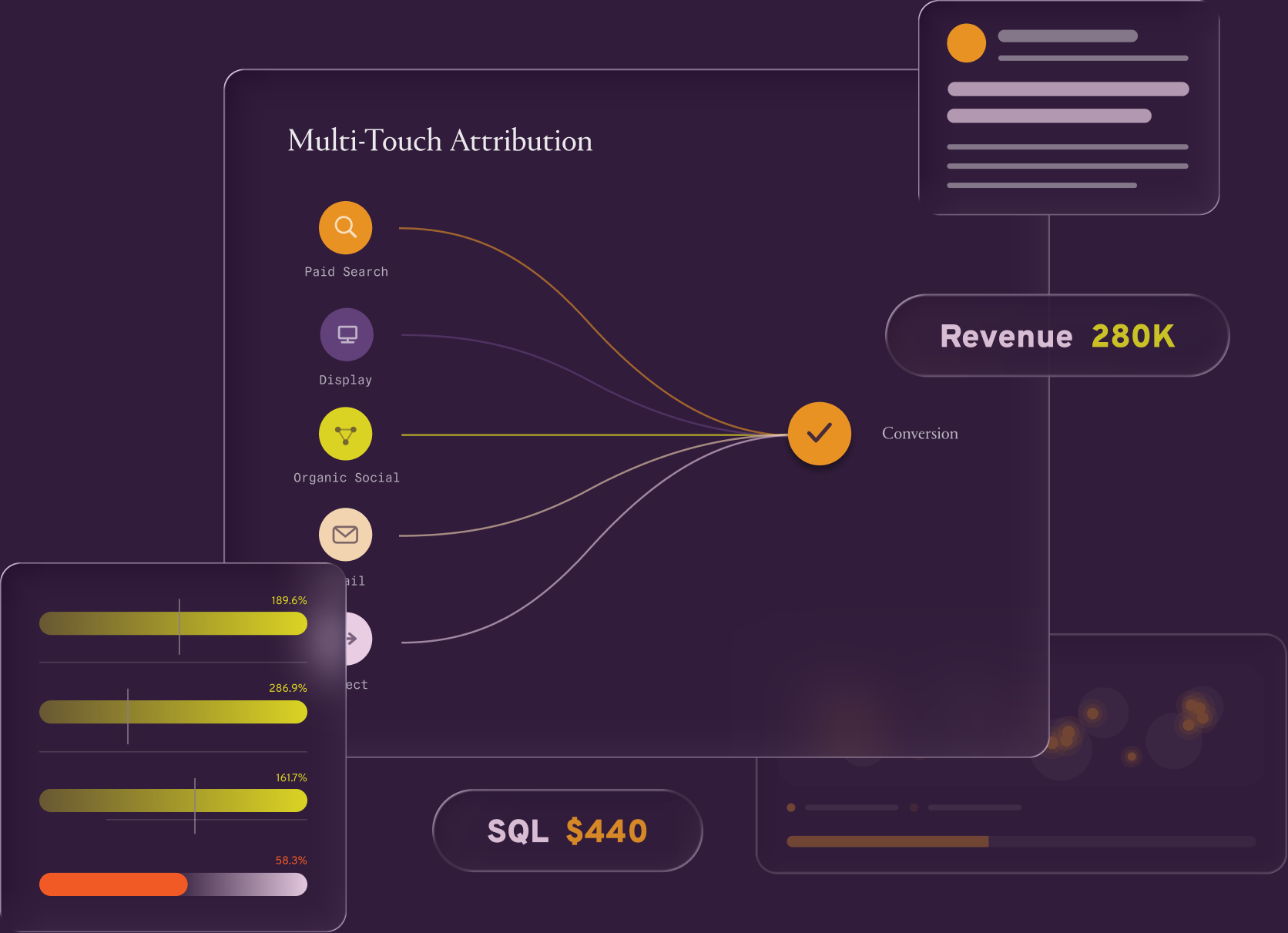
Analytics and attribution graphic with a multi-touch attribution flow, revenue and SQL metrics
Independent measurement outside the ad platforms, so you can see what's driving revenue and what's just claiming credit.
Analytics and attribution graphic with a multi-touch attribution flow, revenue and SQL metrics
We help companies build sustainable growth programs, powered by the right platforms and tools.

Where analytics and attribution go wrong

Every ad platform is incentivized to claim as much credit as possible. Using Meta's attribution to decide whether Meta deserves more budget is like asking someone to grade their own work. Without an independent measurement layer there's no way to know whether your dashboards reflect reality.

Last-click attribution is still the default for most marketing teams. It gives all the credit to the final touchpoint and ignores every channel that built awareness and moved the customer toward conversion, systematically undervaluing upper-funnel investment.

Most teams track channel-level ROAS closely while their overall revenue-to-spend ratio deteriorates. Pixel and tracking drift compounds the problem. A page that drops its tracking due to a website change can corrupt weeks of reporting before anyone notices.

Work With Us

Our approach to analytics and attribution

Every program runs on a single integrated system where measurement informs creative, creative informs media, and media decisions are validated by data. The result is a cycle of learning that compounds over time, not a set of disconnected tactics that reset every quarter.

Independent reporting

Independent reporting built outside ad platforms so performance is evaluated against business outcomes. Conversion tracking is audited and validated before any attribution conclusions are drawn so decisions are never made on unverified data.

Attribution modeling

Attribution model selected based on business context. Sales cycle length, channel mix, and measurement maturity all inform which model is appropriate rather than defaulting to platform recommendations.

Monitoring alerts

Overall program health tracked alongside channel-level metrics so when individual campaigns look healthy but aggregate efficiency is deteriorating, the signal gets caught early. Pixel and tracking monitoring alerts Thrive immediately when a page drops its tracking so data loss doesn't turn into a reporting problem.
Work With Us

How we've helped brands like yours

From proving which channels really drive sales to creative that beats in-house ads, here's what we delivered.

Thrive empowers companies big and small to build sustainable growth programs.

uber
tempurpedic
masterclass
square
asana

“Thrive worked hand-in-hand with our in-house team to craft a bold strategic vision for our digital marketing program, and then ensured that every detail and dollar was accounted for in our campaigns. Asana's acquisition program is more effective thanks to our partnership and co-creation with Thrive.”

smith

“Thrive has been a key partner for helping Smith transform from a traditional wholesale business to a digitally minded consumer-first brand. Helping us acquire new customers for all our channels. They move fast and are extremely proactive”

snapchat
classpass
earnest

“The team at Thrive Digital is great to work with. They are diligent, strategic and deeply focused on the details. Thrive is a rare breed among digital marketing agencies.”

arcteryx
lululemon
coinbase
gofundme
Attribution assigns credit to touchpoints that were present during a conversion journey. Incrementality tests whether those touchpoints actually caused the conversion. Attribution answers which channels were involved. Incrementality answers which channels actually moved the outcome. For budget allocation decisions, incrementality is the more reliable methodology.
Explore incrementality testing
Marketing efficiency ratio (MER) is total revenue divided by total marketing spend. It measures the overall return on the full program rather than individual channels. It's a simple calculation that tells you something channel-level ROAS cannot: whether the program as a whole is getting more or less efficient over time.
Explore marketing mix modeling
By centralizing data in a warehouse that pulls from every source, ad platforms, CRM, GA4, and any other relevant data, and building reporting on top of that reconciled data rather than individual platform dashboards. This makes it possible to compare channels on equal terms and surface discrepancies that in-platform reporting never catches.
Explore data engineering
The right model depends on your sales cycle, channel mix, and measurement maturity. Last-click is simple but an incomplete picture. Data-driven is better but still correlation-based. Thrive uses incrementality testing alongside attribution, with attribution informing tactical decisions and incrementality informing budget allocation.
Explore incrementality testing
Through CRM integration and offline conversion tracking. Sales data from Salesforce, HubSpot, or your CRM gets matched back to ad platform user IDs and uploaded as offline conversion events. This allows campaigns to optimize toward closed deals and qualified opportunities rather than digital conversion proxies.
Explore B2B lead generation