
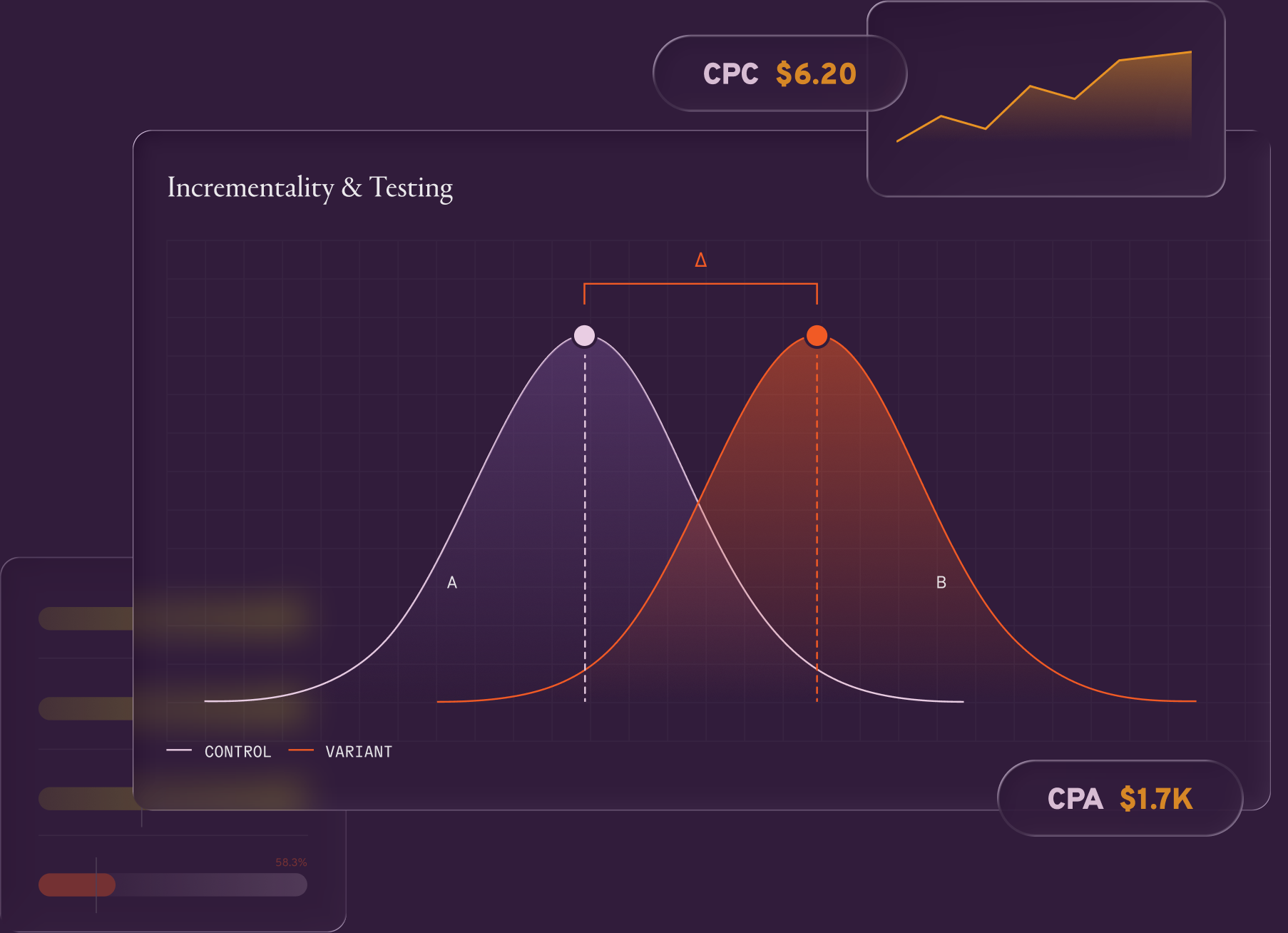






Incrementality & Testing

Incrementality and testing programs that make budget decisions defensible

Incrementality testing graphic comparing control and variant distributions, with CPC and CPA metrics
Geo-holdouts and lift studies that show whether your marketing is causing growth or just showing up near it.
Incrementality testing graphic comparing control and variant distributions, with CPC and CPA metrics
We help companies build sustainable growth programs, powered by the right platforms and tools.

What marketing programs get wrong about incrementality

Attribution tells you which channels were present when a conversion happened. It doesn't tell you whether those channels caused it. Platform attribution is correlation presented as causation, and most programs have never tested whether the credit being claimed is actually earned.

Branded search and retargeting look efficient because they reach people who were already going to convert. Over-investing in these channels at the expense of ones that create new demand is one of the most common and costly mistakes in performance marketing, and standard attribution makes it invisible.

Most brands run tests without a structured framework. Tests without clear hypotheses, success criteria, or decision rules produce data that's interesting but not actionable, leaving an archive of inconclusive results that nobody acts on.

Work With Us

Our approach to incrementality and testing

Every program runs on a single integrated system where measurement informs creative, creative informs media, and media decisions are validated by data. The result is a cycle of learning that compounds over time, not a set of disconnected tactics that reset every quarter.

Geo-holdout testing

Geo-holdout testing splits markets into treatment and control groups so the difference in total business outcomes measures true incremental impact rather than attributed correlation. Conversion lift studies on Meta and Google provide directional signal at lower cost and help prioritize which channels warrant a full geo-holdout experiment.

Structured roadmaps

Structured testing roadmaps are built before any test begins, with a documented hypothesis, minimum detectable effect, required run time for statistical significance, and pre-agreed decision rules so results are actionable the moment they arrive.

Budget allocation

Incrementality findings feed directly back into channel budget allocation. Channels proven to drive net new growth get more investment. Each test produces updated assumptions that generate the next set of hypotheses, compounding into a system of evidence over time.
Work With Us

How we've helped brands like yours

From proving which channels really drive sales to creative that beats in-house ads, here's what we delivered.

Thrive empowers companies big and small to build sustainable growth programs.

uber
tempurpedic
masterclass
square
asana

“Thrive worked hand-in-hand with our in-house team to craft a bold strategic vision for our digital marketing program, and then ensured that every detail and dollar was accounted for in our campaigns. Asana's acquisition program is more effective thanks to our partnership and co-creation with Thrive.”

smith

“Thrive has been a key partner for helping Smith transform from a traditional wholesale business to a digitally minded consumer-first brand. Helping us acquire new customers for all our channels. They move fast and are extremely proactive”

snapchat
classpass
earnest

“The team at Thrive Digital is great to work with. They are diligent, strategic and deeply focused on the details. Thrive is a rare breed among digital marketing agencies.”

arcteryx
lululemon
coinbase
gofundme
A geo-holdout test splits comparable geographic markets into two groups: a treatment group that receives your advertising and a control group that doesn't. By comparing total business outcomes between the two groups during the test period, you measure the true incremental impact of your campaigns rather than relying on attribution that can't distinguish causation from correlation.
Explore marketing mix modeling
Attribution measures which touchpoints were present when a conversion happened. Incrementality measures whether those touchpoints caused the conversion. People who were going to convert anyway show up in attribution data, inflating the reported contribution of bottom-funnel channels and making it impossible to know what's driving genuine growth.
Explore analytics and attribution
It depends on conversion volume and the minimum detectable effect you need to observe. High-volume programs can reach statistical significance in two to three weeks. Lower-volume programs may need six to eight weeks. Thrive calculates required run time before every test begins. Calling a test early based on directional results is one of the most common testing mistakes.
Explore analytics and attribution
Retargeting and branded search, where reported ROAS is highest but incremental contribution is most often overstated. Upper-funnel channels like CTV, display, and brand media, where attribution systematically undercredits. Any channel that's been running for a long time without its contribution being independently validated.
Explore search marketing
Directly. Channels proven to drive net new growth get more budget. Channels claiming credit for conversions that would have happened anyway get less. Reallocation is informed by the incremental cost per outcome from the test, not by platform-reported ROAS.
Explore media planning